Guides & insights
How to Choose the Right Circuit Breaker for Your Panels In Pakistan?
How to Choose the Right Circuit Breaker in Pakistan for Your Panel
A circuit breaker is a small switch that protects your home or shop from electrical faults. Pick the wrong one and you risk wire damage, burnt appliances, or even a fire.
If you are looking for a circuit breaker in Pakistan, you will find many types, sizes, and brands. It can feel confusing. This guide explains everything in simple words, so you can choose the right breaker with confidence.
At Al Ashraf Electric Store, we help electricians, contractors, and homeowners every day. We also offer same day delivery in Karachi.
What Does a Circuit Breaker Do?
A circuit breaker is an automatic switch that cuts off electricity when the current becomes too high or unsafe. It protects wires, appliances, and people.
A fuse works only once. When it burns, you replace it. A breaker can be switched on again after it trips (once the fault is fixed).
A breaker trips for three main reasons:
Overload: too many devices on one line.
Short circuit: live and neutral wires touch each other.
Earth leakage: current leaks to the ground, for example through a person or a wet wall. Only some breakers detect this (RCCB, ELCB, RCBO).
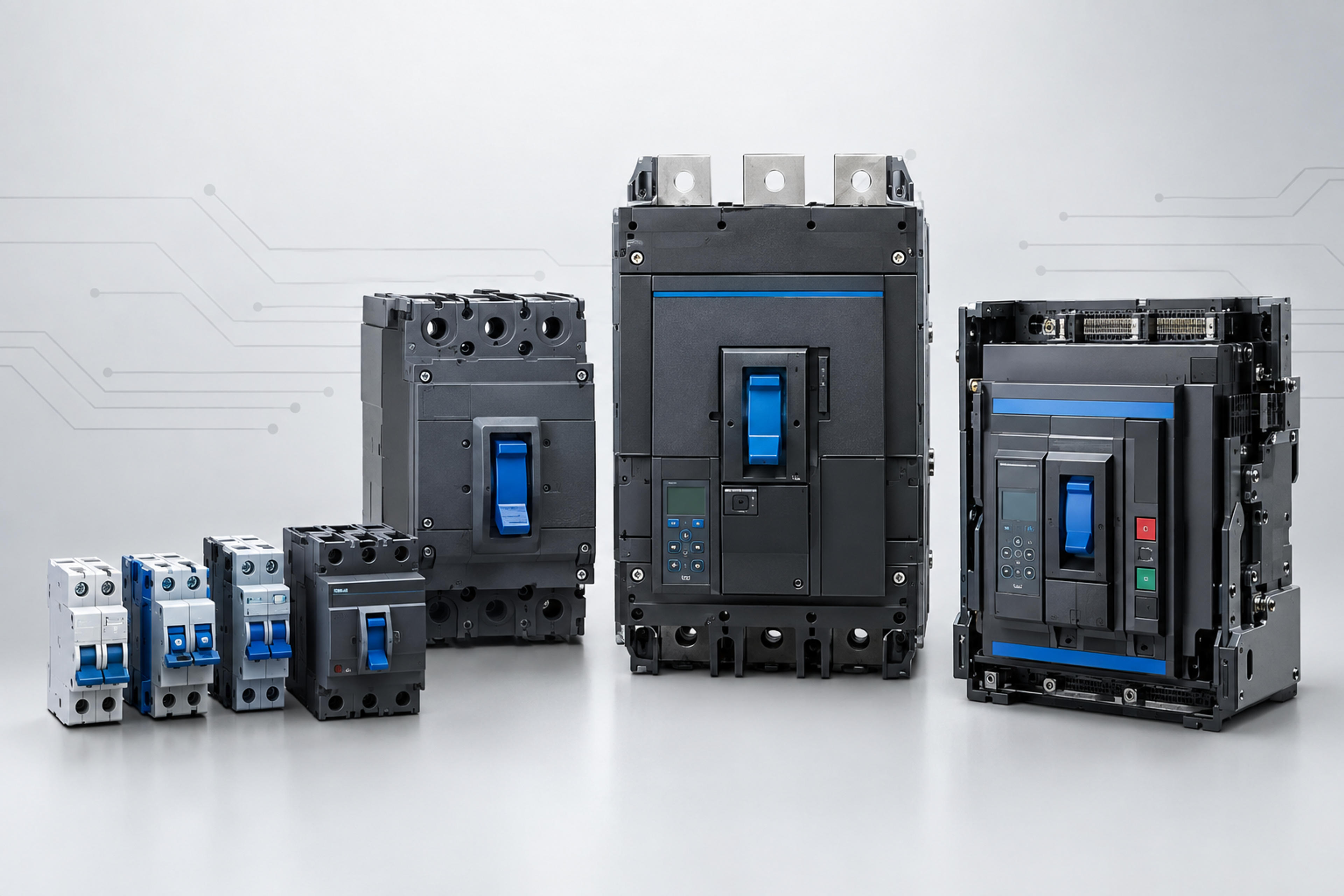
Types of Circuit Breakers
Different jobs need different breakers. Here are the main ones.
Miniature Circuit Breaker (MCB)
The miniature circuit breaker is the most common breaker in homes and small shops. You will also hear it called MCB breaker, ckt breaker, or simply breaker switch.
Usually used from about 6A to 63A.
Protects against overload and short circuit.
Fits on a DIN rail inside a distribution board.
Browse our MCB and AC breakers for home and light commercial use.
Molded Case Circuit Breaker (MCCB)
An MCCB breaker is for bigger loads. Think factories, workshops, large buildings, and main incoming lines.
Handles higher current than an MCB.
Many models let you adjust the trip setting.
Comes in a strong molded case.
See our range of AC MCCB breakers.
Air Circuit Breaker (ACB)
An air circuit breaker is used in large industrial and commercial panels. It handles very high current. Most homeowners will never need one. Contractors working on big projects might.
RCCB (Residual Current Circuit Breaker)
An RCCB breaker protects people from electric shock. It watches the current going out and coming back. If some current is missing, it means it is leaking, so the RCCB trips fast.
Important: an RCCB does not protect against overload or short circuit. You must use it together with an MCB.
ELCB and Earth Leakage Breaker
ELCB breaker, earth leakage breaker, earth circuit breaker, and leakage circuit breaker are names people use for breakers that protect against leakage.
There is a small technical difference. Older ELCBs sense voltage on the earth wire. Modern RCCBs sense current. Today, RCCB is the more common choice. If a shop shows you an "ELCB," ask whether it is voltage-operated or current-operated.
RCBO (Two Protections in One)
An RCBO breaker (or RCBO circuit breaker) combines an MCB and an RCCB in one unit. It protects against overload, short circuit, and earth leakage.
It is very useful when you want each circuit protected on its own. If one line leaks, only that line trips.
Motor Circuit Protector (MCP)
A motor circuit protector protects motors from short circuits. Motors pull a big surge of current when they start. A normal breaker may trip for no reason. An MCP is made to handle this. It is used for pumps, compressors, and machines.
DC Breaker
A DC breaker is made for direct current. You need it in solar systems (between panels, inverters, and batteries).
Do not use a normal AC breaker on a DC line. DC current does not drop to zero like AC does, so the spark (arc) is harder to stop. A wrong breaker can be dangerous.
Explore our DC circuit breakers for solar setups.
Changeover Breaker
A changeover breaker (more properly a changeover switch) shifts your load between two power sources, for example WAPDA and a generator. It also stops both sources from feeding the line at once.
AC Circuit Breaker vs DC Breaker
An AC circuit breaker (or ac breaker) is for normal wall power. A DC one is for solar and batteries. They are not interchangeable.
Quick Comparison Table
Breaker | Best For | Protects Against |
MCB | Homes, shops, small circuits | Overload, short circuit |
MCCB | Factories, big buildings, main lines | Overload, short circuit (higher current) |
ACB | Large industrial panels | Overload, short circuit (very high current) |
RCCB | Every home and shop | Shock from earth leakage |
ELCB | Older wiring systems | Earth leakage |
RCBO | Single circuits needing full safety | Overload, short circuit, earth leakage |
MCP | Motors, pumps | Short circuit |
DC breaker | Solar systems | Overload, short circuit on DC |
How to Choose a Circuit Breaker: 6 Simple Steps
Follow these steps before you buy.
Find the load (in amps).
Check your wire size.
Pick the right amp rating.
Choose the poles.
Check the breaking capacity.
Pick the trip curve.
Let us look at each step.
Step 1: Find the Load in Amps
Use this simple formula for single-phase power:
Amps = Watts ÷ Volts
Pakistan's normal home voltage is 230V. Here is an example:
A 3,000W geyser ÷ 230V = about 13 amps.
Always check the nameplate on the appliance. It tells you the real power.
Step 2: Check Your Wire Size
The breaker must protect the wire. If the breaker is too big, the wire can overheat before the breaker trips.
Rule: the breaker rating should be higher than the load, but lower than what the wire can safely carry.
Wire safe limits depend on the cable type, length, and how it is installed. Ask a qualified electrician to confirm this. Do not guess.
Step 3: Pick the Right Amp Rating
Choose a rating just above your load. Do not go far above it.
For the geyser above (13A), a 16A breaker is a sensible starting point, if the wire allows it.
Common ratings sold in the market are 6A, 10A, 16A, 20A, 25A, 32A, 40A, 50A, and 63A.
A bigger breaker is not safer. It only trips later, which can be too late.
Step 4: Choose the Number of Poles
Poles | Used For |
1P | One live wire (lights, sockets) |
2P | Live and neutral (main switch in single-phase homes) |
3P | Three-phase supply (motors, workshops) |
4P | Three-phase with neutral |
Step 5: Check the Breaking Capacity
Breaking capacity (in kA) is the biggest fault current the breaker can safely stop. Common values on MCBs are 4.5kA, 6kA, and 10kA.
A higher value is better for places close to the main transformer, or in big buildings. Ask your electrician what fault level your panel may face.
Step 6: Pick the Trip Curve
The curve decides how the breaker reacts to short surges.
B curve: trips quickly. Good for lights and normal sockets.
C curve: handles medium surges. Good for ACs, small motors, and general use.
D curve: handles big surges. Good for large motors and machines.
If you are unsure, C curve is common for general use. But motors and special loads need proper advice.
Which Breaker for Which Job?
This table is a starting guide. Final choice depends on your wire, load, and panel design. Confirm with a licensed electrician.
Job | Suggested Breaker Type |
Room lights | MCB (B curve) |
Sockets | MCB + RCCB or RCBO |
Split AC | MCB (C curve), sized to the AC nameplate |
Geyser or iron | MCB + RCCB or RCBO |
Water pump or motor | MCB (C or D curve) or MCP |
Main incoming (home) | 2P MCB or MCCB |
Workshop or factory | MCCB, and ACB for large loads |
Solar panel side | DC breaker |
Generator and WAPDA switching | Changeover switch |
Brands: Chint, Schneider, and Others
Buyers often ask for a Chint breaker or Schneider breakers. Both are well-known names in the electrical trade. Choose a brand that you trust and that has spare parts and support in your city.
Whatever brand you pick:
Buy from a trusted seller. Fake or low-quality breakers are a real risk in any market.
Check that the label shows the rating, voltage, breaking capacity, and standard (look for IEC markings, for example IEC 60898-1 for MCBs).
Keep the invoice.
At Al Ashraf Electric Store, you can browse the full circuit breakers collection and compare options in one place.
Common Mistakes to Avoid
Using a bigger breaker because it keeps tripping. A tripping breaker is a warning. Find the cause first.
Using only an MCB in wet areas. Add an RCCB or RCBO for shock protection.
Using an AC breaker on a solar DC line. This is dangerous.
Mixing loose, unmarked breakers in one panel. Use matching, labeled parts.
Ignoring loose connections. Loose wires get hot. Tighten terminals properly.
Buying the cheapest one without checking the label. Ratings and standards matter.
Working on a live panel. Always switch off the main supply first.
Safety note: This guide is for general information. For panel wiring and installation, use a qualified electrician who follows local rules and safety standards.
Buy a Circuit Breaker in Pakistan with Confidence
Choosing the right breaker is easier when you know your load, wire size, and protection needs. And buying from a store you trust makes it safer.
Al Ashraf Electric Store offers MCBs, MCCBs, RCCBs, RCBOs, DC breakers, and more. We are here for electricians, contractors, and homeowners who like to buy on their own.
We offer same day delivery in Karachi, so your project does not have to wait.
Visit alashrafelectric.com to see products, or start with our circuit breakers category.
Frequently Asked Questions
1. What size circuit breaker do I need for my home?
It depends on your load and wire size. Divide the appliance watts by 230 to get amps, then choose a breaker just above that number, without exceeding the wire's safe limit. Ask an electrician to confirm.
2. What is the difference between MCB and MCCB?
An MCB is smaller and used for lower current, like home circuits. An MCCB is larger and used for higher current, like factories and main lines. Many MCCBs also have adjustable settings.
3. Do I need an RCCB if I already have an MCB?
Yes, in most cases it is a good idea. An MCB does not protect people from electric shock caused by leakage. An RCCB does.
4. What is the difference between RCCB and RCBO?
An RCCB protects against earth leakage only. An RCBO does that and also protects against overload and short circuit.
5. Can I use an AC breaker for solar panels?
No. Solar panels produce DC power. Use a breaker made and rated for DC.
6. Why does my breaker keep tripping?
Common causes are overload, a short circuit, a faulty appliance, or a damaged wire. Unplug devices, then switch on again. If it trips again, call an electrician. Do not replace it with a bigger breaker.
7. Do you deliver breakers in Karachi on the same day?
Yes. Al Ashraf Electric Store offers same day delivery in Karachi.